Sunday, April 17, 2016
TOW #24: IRB Post
In the second half of Blood Will Out: The True Story of a Murder, a Mystery, and a Masquerade, we witness Walter Kirn, the critically acclaimed author of this book, unravel more of the true identity of Clark Rockefeller. While the first half of the book discussed mainly how Clark Rockefeller cloaked his past well, the second half of the book mainly focuses on his flaws. One example of this would be how earlier in the book Kirn described Rockefeller's house as modern and very well decorated with expensive art, while in the second half of the book he discusses how the art was found later to simply be reproductions. The second half of the book also goes deeper into Rockefeller’s intentions as a serial imposter, going into why he manipulated his wife to stick around with him as well as why he went about kidnapping his “daughter”. This later goes into Kirns first time communicating with Rockefeller in custody as someone other than his aliases. This brings the reader deeper into the mind of the serial imposter as Kirn witnesses Rockefellers responses to his questions. While this is an interesting approach as to how to pull the reader in, the book still poorly displays the true mystery to Rockefeller. While the book was an interesting read being that it was from the point of view of someone who personally knew the criminal, the book is mainly an account of Kirn’s memories as opposed to the mystery Kirn paints the book to be. Because of this, it is hard for the book to live up to its standards. Yes, audiences will be willing to read it to get the experience it provides, but the presentation of the book was misleading from many aspects, including the title itself which displayed a book much more dramatic and eerie than it actually was. Because of this, the book did not live up to the standards I would have liked it to.

Sunday, April 10, 2016
TOW #23: Nonfiction Text
In the article entitled “Why Trump Are Angry- and Loyal” by the New York Times Editorial Board, we go into exactly why so many people who are supportive of Trump more often than not defend him for his actions despite the lack of morality they may behold. The article is introduced by introducing Cruz supporter reactions to that of the people who support Trump. By doing so, the Editorial Board realizes that the majority of the people reading the article are Republican supporters who oppose Trump. This not only gives the reader more of an insight into the viewpoints of Cruz and Trump supporters, but it also plays a role in pathos. By quoting Cruz supporters within the article, such as Erick Erickson who goes as far as to say that Trump supporters are “are white supremacists, neo-Nazis, a white victim class of mostly blue-collar workers, a group of white folks who have failed at life and blame everyone else for their own bad decisions” (para. 4), the audience is able to be eased into the Editorial Board’s view on Trump Supporters. This article goes on to explain how the reason why Trump supporters are so defensive is because Trump promises safety for those who have experienced trouble during the times of the recession. This is achieved by playing the blame game, which was often used against the Bush administration when Jeb Bush was still in the presidential race, as well as promising many radical ideas such as a wall. As one Trump supporter by the name of Kraig Moss sees it, whose son died of a heroin abuse in New York City, Trump is trying to keep drugs out of the country; the same drugs that killed his son a year prior to Trump's candidacy. While Trump in many cases is simply using his supporters weaknesses for his benefits, it is very plausible to understand why Trump supporters are defensive of him. I believe that The Editorial Board did a great job introducing its ideas and I believe that it did a very good job at introducing its ideas to an audience consisting of very opposite viewpoints of Trump supporters.
Sunday, April 3, 2016
TOW#22: Nonfiction Text
In the article entitled “How Virtual Reality Will Change Our Lives” by The Onion, we witness a satirical take on the over exemplified image that modern day technology is given, specifically virtual reality. Through the development of technology such as the Oculus Rift and Samsung's development of virtual reality headsets, the possibilities that this technology can bring us are often emphasized entirely. While the technology has the potential to be revolutionary, it is merely a gadget that will be used by the public as a toy rather than a tool. By listing satirical examples as seen within the article, The Onion utterly solidifies its argument by presenting to its audience what virtually reality is really bound to be. By saying that tourism “Could very well grind to screeching halt once travelers realize they can experience Liberty Bell from comfort of own living room,” (The Onion 6) the audience sees just how pointless the idea of virtual reality is as a consumer good. Virtual reality cannot replace our evergoing reality and can merely serve as a source of entertainment. The assumption that people would rather witness a virtual representation of something as opposed to the real thing is invalid and will never become a reality. Yes, virtual reality may be useful, however, it cannot replace what we already have and is simply a piece of technology that is being overhyped within the moment due to its uniqueness compared to other consumer goods. I believe that the Onion does a great job presenting this argument to consumers, representing just exactly what virtual reality and other new forms of technology have to present.
Sunday, March 13, 2016
TOW #21: Visual Text
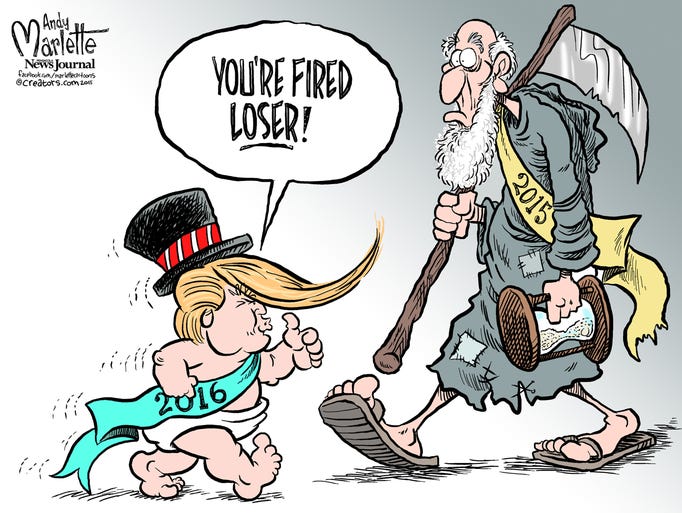
In this political cartoon by Andy Marlette, a political cartoonist for the Pensacola News Journal in Florida as well as the nephew of Pulitzer Prize winning cartoonist Doug Marlette, Marlette presents the issue of Donald Trump's popular image within the Republican candidacy. By placing Donald Trump as the new and upcoming Father Time going into 2016, Marlette is trying to emphasize how big of a role Donald Trump will play within the year due to his already popular image in the media. By making Donald Trump tell the old father time of 2015 “You're fired loser,” Marlette paints as picture for an audience of voters how immature and ignorant Trump i of others. He makes Trump out to be the control freak that he is by taking over 2016. Overall, I believe that this is a great representation of Donald Trump due to the message it sends to the public. While the cartoon is strong however, it lacks in a sense that it only references how big of a threat Donald Trump is in the year 2016. By doing so, Marlette recommends that Trump does not have a chance at winning the presidency. While his view is that he obviously opposes Donald Trump, he must make it clear to his audience members how big of a threat Donald Trump could be if his campaign does end up succeeding. By just referencing 2016, the political cartoon comes off nearly as a joke as to how Donald Trump's presidential race appears currently opposed to a message about the dangers this presidential race could lead to. This is how Andy Marlette message tends to fail in informing his audience of the repercussions that may occur as a result of the 2016 presidential election.
Sunday, March 6, 2016
TOW #20: IRB Post
In the first half of the book entitled Blood Will Out: The True Story of A Murder, A Mystery, and A Masquerade, Walter Kirn, the author and main character of the plotline, goes back to the summer of 1998 where he befriended the modern day monster known as Clark Rockefeller. What started as a Kirn simply selling his three-legged dog from his home in Montana to New York City to give the dog to Rockefeller , turned into a 15 year friendship between the two. Clark Rockefeller was a strange man who claimed to be a banker and an art collector, inheriting most of his wealth from his family past as one of the wealthiest families in American History. Written in past tense, Kirn tells his story of his encounters with rockefeller as past experiences, making the audience initially aware of Rockefeller’s true identity: A serial imposter, murderer, and Child kidnapper by the name of Christian Karl Gerhartsreiter. By doing this, Walter Kirn attempts to put his audience in his shoes; trying to make them spot the signs that Kirn could not spot himself while unaware of Rockefeller's past. While this seems clever however, I believe that Kirn does not do as good of a job as he could have at putting his audience in that position. Portraying to an audience interested in true mystery, the audience expects a story full of detail. The one thing I do not enjoy about this book is how despite how close Kirn was with the imposter, he does not provide enough detail to put the reader in the position he was in. Being that he had physical contact with Clark Rockefeller himself for a 15 year period, you would expect Kirn to apply an abundance of detail to his storyline, but in most cases his recalls of the past are merely him explaining what happened as opposed to letting the reader figure it out themselves. Because of this lack of detail I believe that the first half of the book was weak at its ability to appeal directly to its audience.
Sunday, February 28, 2016
TOW #19: Nonfiction Piece
In the editorial entitled “Another Year, Another Oscar Whiteout”, The LA Times Editorial board, apart of a very successful newspaper distributor located within Los Angeles California, discusses the fact that the Oscars have gone two years in a row without nominating a single person of color for any of the four acting categories. The editorial board discusses how outrageous this is due to the number of movies present within the years 2015 to 2016 that involved tremendous directing as well as acting by people of color. The board then proceeds to argue that this lack of diversity is due to a lack of risk in the film industry on “unfamiliar talent”. This is then brought into the defense that due to the election of Cheryl Boone Isaac as film director of the Academy, there may be a broader spectrum of diversity brought into the Oscar Academy Awards in the future. While it is not believed that this will be an instant change, it is believed that there will be a wider range of diversity brought into the voting process of which films become nominated for the categories due to more “viewpoints and sensibilities to bear when voting”. While I agree this may be true however, I believe that these viewpoints may not change at all in certain cases. While the president of the academy may be African American, it is not correct to state that because of that change, there will be more of a change in which films are brought into the nominations. That is not something that can be decided by the Academy in all scenarios. The problem in itself would be the lack of diversity within films, however, I believe that in recent years film industries have been doing a great job at bringing that diversity in. While there is still much work to be done, films such as Star Wars: The Force Awakens, there were actors of very different diversity. While the Academy must make an effort as well to increase this diversity, the problem must not be blamed solely on the Academy. Yes, it is very questionable as to how and why films such as Creed and Straight Outta Compton did not get nominated for any awards, however, it is also very unquestionable as to why films such as Mad Max and many others were nominated for such awards. In order to see this increase in diversity, there must be an effort put in by both the Academy in nominations, as well as the film industry in increasing their own diversity through directing and cast.
Sunday, February 21, 2016
TOW #18: Nonfiction Piece
In the editorial titled “Young Voters, Motivated Again” by the editorial board at New York Times, the topic of the involvement of young voters in the current election is discussed. Within the editorial piece, the editorial board talks about exactly why there has been such a large involvement in the presidential race by young voters compared to past elections. This is because of the appeal that the current candidates show towards the youth. Ironically enough, Bernie Sanders, who is the oldest of the candidates, manages to pull in the most youth support. This is due to Sanders ability to deliver his message of creating change within the nation. This message echoes to the youth, who crave such change within the United States, and enables them to become apart of the campaign. The Editorial Board enforces this point by using ethos in order to validate their point of view. By quoting sources such as Harvard, The Editorial Board manages to credit their argument as to why the youth have gained such an interest in voting. These sources cause the audience, consisting of Americans who may be interested in the current voting trends or who are the least bit curious as to where Sanders support has come from, to take the word of the editorial board. Because of the effective use of ethos within this editorial piece, I believe that the editorial board does a great job at backing up their point, however, I do not believe that the editorial piece did a good enough job at crafting an argument. While the editorial board succeeds at telling their audience why the believe their is such a high increase in youth support in the current election, they do not succeed in explaining their views on what the increase means. In order to make the piece more opinionated, the editorial board must discuss what they believe the increase means, not discuss why it has occurred. These are my thoughts on the editorial piece “Young Voters, Motivated Again”.
Subscribe to:
Comments (Atom)